[[getLangText('background')]]
Endoscopic submucosal dissection (ESD) serves as a critical treatment modality for superficial esophageal cancer (SEC). However, non-curative resection(NCR) is significantly associated with residual tumors and unfavorable prognosis. An effective preoperative predictive tool is currently lacking. This study aimed to develop and validate a machine learning-based prediction model for accurate preoperative assessment of the risk of non-curative ESD resection.
[[getLangText('parameter_description')]]
preoperative pathological type:
circumferential ratio:
Multiple lesions:
Esophageal stricture:
EOM:
Thickness:
This study, utilizing a multicenter cohort from the Affiliated Hospital of North Sichuan Medical College (training cohort, n = 366) and Langzhong People’s Hospital (independent external validation cohort, n = 129), developed and validated for the first time a preoperative prediction model for the risk of non-curative ESD. Variable selection was performed using LASSO regression, and key predictors—including six SEC-specific features such as preoperative endoscopically estimated deep submucosal invasion (EOM), esophageal stricture, and CR≥ 3/4—were identified via multivariable logistic regression. The predictive performance of nine machine learning classifiers was systematically compared. The optimal model was integrated with SHAP to achieve individualized risk visualization, providing transparent and reliable decision support for clinical practice.
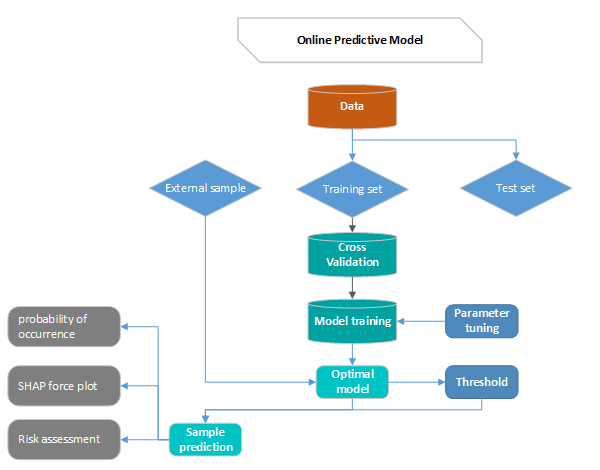
Principle:
First divide the data into training set and test set, then use the cross-validation method to train the model in the training set, train the optimal model as the final model and record the threshold at this time as the final threshold, and finally observe the model in the test performance on the set. By continuously adjusting the parameters of the model, the generalization ability of the model is improved, and the performance of the model in the training set, validation set and test set is relatively optimal.
By the predicted sample into the optimal model, the model will predict the probability of occurrence, generate the SHAP force plot, and then evaluate the risk according to the predicted probability and prediction.